Farmers make hundreds of decisions each season, often with incomplete information and considerable uncertainty. Whether evaluating a new technology, refining an existing practice, or responding to changing conditions, there is rarely a single source of information that provides a complete answer.
Too often, agricultural decisions rely on only one type of evidence. Research findings may not reflect commercial farm conditions. Observations from a single farm may not apply elsewhere. Data can reveal patterns but not necessarily explain them. Experiments can demonstrate differences but may not explain why they occur. Even the best results have limited impact if they are not shared and discussed.
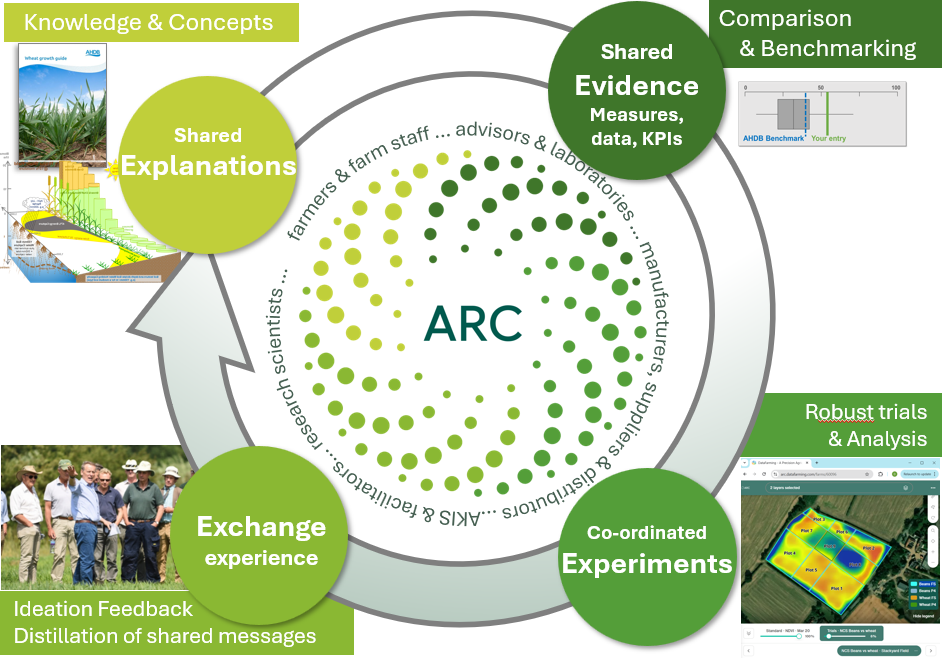
At ARC, we believe that understanding what works on-farm requires multiple sources of knowledge working together. We use four complementary elements – Explain, Evidence, Experiment and Exchange – to structure projects, develop understanding and generate practical knowledge.
The four elements are not a rigid process. They reinforce one another and can occur simultaneously. A shared explanation helps identify what should be measured. Evidence helps generate hypotheses for experiments. Experiments strengthen the evidence base. Exchange challenges assumptions, shares learning and often generates the next set of questions.
Together, the four Es provide a practical framework for helping farmers, researchers, advisors and technology providers develop knowledge that supports better-informed decisions and continuous improvement.
Explore in more depth how we are working with each of the four elements - Explain Evidence Experiment Exchange